
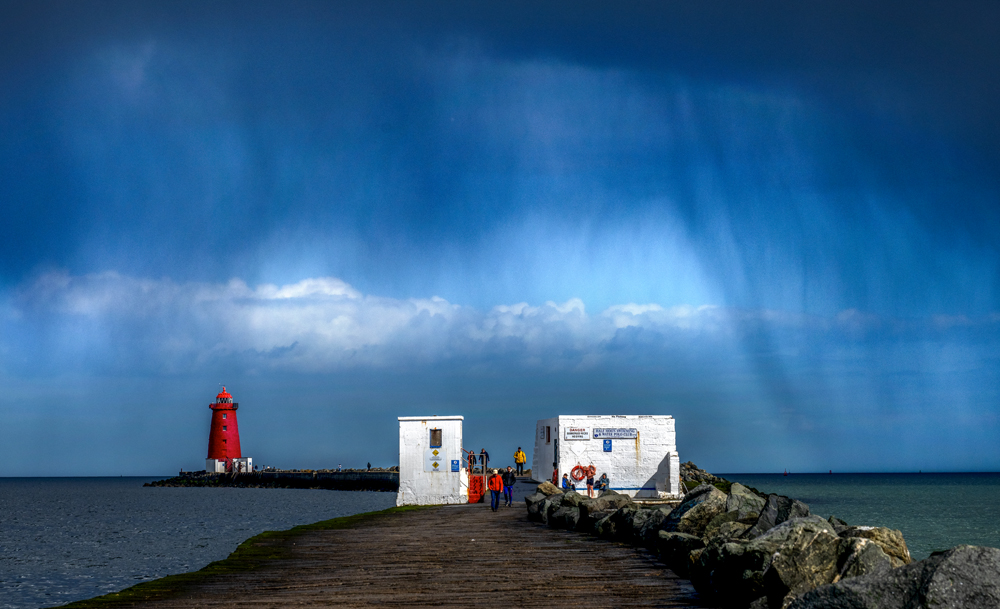
The photographer responsible for On Dublin (published by Little Museum of Dublin 2026, with words by Louise East) is my aunt, the sister of my biological father, both of whom I met for the first time when I was 25 in Los Angeles. That meeting was the beginning of my relationship with that part of my family, which happens also, incidentally, to be the Irish-descendent side. Many years later, I accompanied Deanne when she flew to Dublin to start work on the photos which became On Dublin.
Deanne and I made an instant connection. At the time she was a globetrotting staff photographer for the San Francisco Chronicle. I had gone to journalism school and worked for several newspapers. I was struggling as a writer and had begun traveling frequently to St. Petersburg, Russia, indulging my fascination with Russian literature in the city of Gogol’s overcoat and Dostoevsky’s philosophical murderer.
It was a strange period of my life, and that connection with Deanne meant a great deal to me, much more than I even realised at the time.
We started meeting regularly, first just once a year or so and then more often. We’d have long wine-soaked conversations about art, about what she was working on, about what I was working on, about where we’d been and what we’d done and seen. There was a surprising amount of overlap in our ideas about storytelling in our respective forms—I recognized in her work formal and aesthetic features that I tried for in my stories and novels: Patterning and framing and repetition, an emphasis on gesture and tiny details, comedy (downright silliness at times), and an attraction to place, specifically a desire to see the world and represent the world in a way that was, I think, just a little bit off, to defamiliarize the world, to use Shklovsky’s term, so that we who are so habituated to it can see it anew.
Of course I’m biased in my regard for her work, and yet I’m somewhat embarrassed to say that it was not until she won the Pulitzer Prize in 2005 that I recognized the full range of her subtle talent as a visual storyteller, an optical technician, and a fearless, interminably patient, driven, and charismatic artist.
The series of photos that earned her that honor is about the young Iraqi boy Saleh, who was injured by a mine and rehabilitated at the San Francisco Children’s Hospital. It’s startling, a poetic visual narrative that’s also deeply disturbing as it forces you to confront the inevitable results of war, the physical cost for one young boy, the wick of intergenerational trauma it lights. She has continued shooting Saleh’s story for more than 20 years now and the project has taken on even more resonance.
And while Deanne is capable of such serious, powerful work, her range is unlimited. She’s a remarkable concert and performance photographer, always finding her way to just the right angle for just the right shot that captures something beautiful or unusual if not the essence of the event itself. She’s shot numerous NBA Finals and Superbowls for Sports Illustrated and ESPN. She’s probably most noted for documenting another great city, San Francisco—her photos of the earthquake are striking historical records. While she left the Chronicle years ago she’s still called on to shoot hard news for NPR and the New York Times and others.
My favourite photo of hers is one in which ten adult goats are perched high in an argon tree in Morocco at just the moment a young goat looks up at them, tiny gestures in its neck and ears suggesting that it’s aspiring one day to climb argon trees too. It’s almost like an image from a child’s storybook.
Deanne is responsible for my introduction to Dublin. I accompanied her there in December of 2022, the first of her trips to capture the photos in her book and the centenary of the publication of Ulysses. The Joycean anniversary seemed significant in that it felt like a similar kind of transformational moment for Ireland (if not for the whole world) that 1922 was. We were still emerging from the global pandemic, and a brutal war the likes the continent had not seen since World War II was being waged in Ukraine. Ireland and particularly the capital were facing myriad complex phenomena: a housing crisis, the realities of a precarious economy built largely on American technological investment, lack of resources to support several recent waves of immigrations, among others.
And yet from the street-level perspective the most salient impression for me of “the heart of the Hibernian Metropolis” was that holiday parties were back. It was the first season since the pandemic that the tradition was again in full swing, and bars and pubs were mobbed with sharply dressed revelers. Even the courtyard outside my hotel window was packed night after night despite the cold, a penetrating, marine cold that seeps through you, unlike the dry New England cold which proper layering can block out; Boney M, the Pogues, and George Michael serenaded me to sleep every night.
I wandered as much as I could and talked to as many interesting people as would agree to meet with me. I wanted to get a sense for the place, a place that had born so many of my favourite writers.
Many countries were dealing with quandaries like those Ireland faced and so when I put the question to one of the most brilliant and knowledgeable characters in Ireland, Catriona Crowe, What makes Dublin different? she answered directly with no hesitation in one word: “Joyce.”
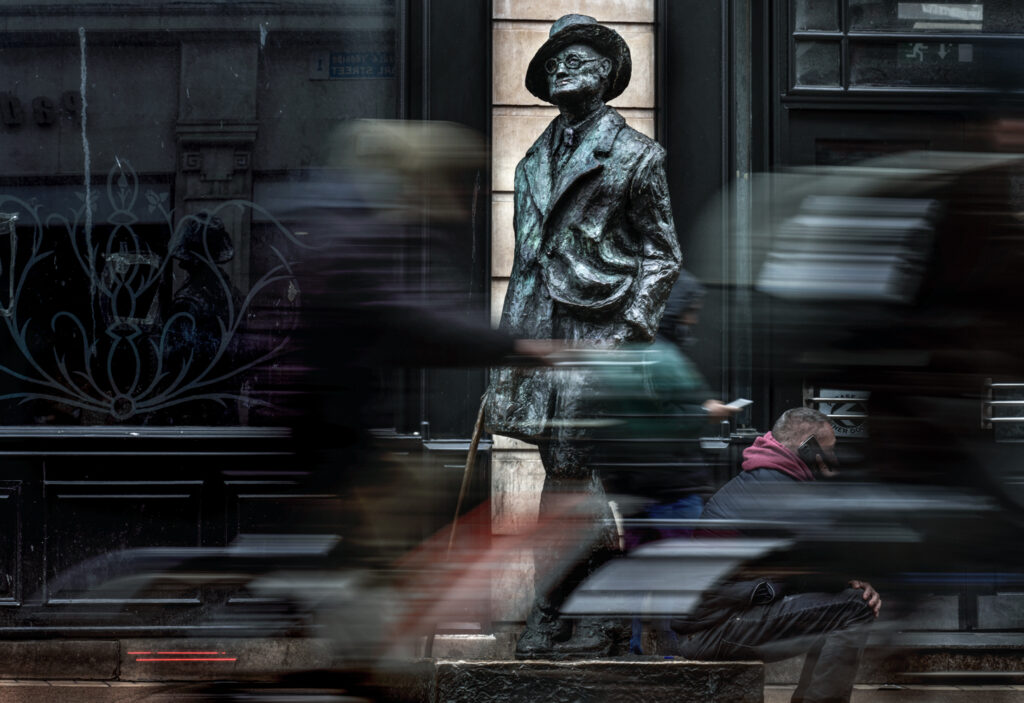
At the Ballybough Community Centre, Peter Sheekey’s approach to welcoming immigrants is centered around storytelling, teaching them how to tell their stories in their new culture to maintain their identity and combat isolation.
Active in poetry circles and a proud member of the Dublin “liveaboard” community (for those who live on boats rather than on land), Peter is one of a handful of folks I met who cautioned that one of the most perilous storylines of the time in Ireland is the growing anti-immigrant sentiment. “More and more Irish people are being caught in this right-wing trap, and the authorities are very happy about this because they don’t get blamed,” he said. “Migrants get blamed.”
Declan Meade, Co-Founder and Publisher of the internationally renowned literary journal Stinging Fly, echoed Peter when we met at the Museum of Literature Ireland (aka the MOLI, in homage to Molly Bloom). “Five years ago we’d have dismissed outright the notion of a far-right presence in our society,” he said. “Not now.”
On a particularly cold day, I went to see Joyce’s death mask at the drafty James Joyce Centre and I was still puzzling over how small his head seemed, too small certainly to contain all of Ulysses’ vastness, while warming my hands by the fireplace, when the Director Darina Gallagher appeared. We struck up a conversation and she told me how excited she was about the resurgence in the Dublin sea-swimming scene since Covid. She and an associate were sitting by the fire on a couch as they proofed a deck of Joyce cards designed by Anthony Burgess. They invited me to join them and give my take on the proofs. They offered me danishes and tea.
At the Abbey Theatre, I caught a production of The Weir by Dublin native Conor McPherson. Nothing much happens in the striking performance, but it’s a tribute in a way to Irish storytelling. Upon a minimalistic, ethereal set depicting a grungy village pub in Leitrim, four characters recount their experiences of the supernatural.
I think it was in the living-book exhibit that is the Book of Kells at Trinity when a most obvious epiphany obtained: Dublin is a place of storytellers, storytelling, and characters. I apologise if this seems a generalization that may well be true of anywhere. But Dublin is a text itself perpetually rewriting and revising itself before our very eyes. What a great concept then to unleash one of America’s foremost visual narrative photographers on the city whose literary artists have redefined literature again and again for this new portrait.
In these photographs I sense all the impressions I got there myself: the periodic squawk of gulls, music wafting from a busker down a side street, skid of a horse’s hooves as it approaches an intersection too fast for its driver’s liking, the smell of fresh-cut flowers and stale beer and fish and chip grease, the salty sea.
Deanne captures the surprise that Dublin is happy to provide: For me it was things like a hardware store with a flyer in the window advertising a philosophy lecture on Socrates; mint tea ordered in a small café served de facto with milk.
“Deanne captures the surprise that Dublin is happy to provide.”
You can see that the Irish have great smiles and even better scowls. Their politeness is cut with just the right edge of menace. They may say, “No worries,” even more than Americans or Brits.
Deanne and I would meet in the evenings for dinner, and she’d tell me about her adventures around the city. She was trying to faithfully see the city as a stranger, and I recounted what foreign journalists said about reporting on the Soviet Union: after a week they felt they could write an article, after a month they felt they could write a book, and after a year they didn’t feel they could write anything.
I think this may be a truism about writing about any place. There’s something about fresh eyes, about being free of the burden of certain prejudices and knowledge that leads to a different kind of portrait.
I remember Deanne telling me one evening about the daily inter-species battle she witnessed between the Irish trying to enjoy their lunch and the seagulls in St. Stephen’s Green. She had been trying to capture one at just the moment it heisted a sandwich. She hadn’t captured it yet but she was determined and at the same time she worried that it might be a bit too touristic of a shot. She ended up finding an accomplice, an associate of a flower hawker on Grafton Street, who told her just where to stand, and the result is the three-photo series of a seagull divebombing a little girl and flying off with her McDonald’s Chicken Nugget.
In these photographs Deanne has drawn on all her many talents to capture Dublin in its multifaceted complexity, above and below the surface, from the quotidian, a busser with forty dirty pint glasses in his arms, to underground urban horse culture, a major rugby match, a drag show at The George. Joyce said that if one could get to the heart of Dublin one could get to the heart of any city in the world, and here Deanne brings our ear close to the chest.
Jeff Parker is the author of several books, most recently Where Bears Roam the Streets: A Russian Journal (Harper Collins). His writing has been selected for The Best American Nonrequired Reading, the Tin House New Voices series, and the Ploughshares Emerging Writers issue, and his work has appeared in McSweeney’s, n+1, American Short Fiction, The Walrus, and many other publications. He is the founder and Director of the DISQUIET International Literary Program in Lisbon, Portugal, and he teaches prose in the MFA Program at the University of Massachusetts Amherst.